Spryker Agency: integrations, frontends and audits
SPRYKER COMPOSABLE B2B COMMERCE

Spryker is a Berlin-based commerce platform for B2B, marketplaces and enterprise retail, delivered as PaaS. We support Spryker projects with integrations, headless frontends and extensions – and give you a neutral view of whether Spryker or Shopware 6 fits you better.
Spryker in figures
- 39
- 12
- 3.87.1
- 30K
What does a Spryker agency do?
A Spryker agency designs, extends and integrates shops and portals on the Spryker commerce platform. nextlevels supports ERP and PIM integrations via the Glue API, headless frontends and PHP extensions. In an audit we also assess honestly whether Spryker or Shopware 6 is the better choice for your B2B project.
Price rules, live – B2C or B2B
Switch the customer group, change quantities and apply a coupon: group price, tier price, free-shipping threshold and VAT recalculate instantly. The list shows which rule changed the price. Example products and prices, calculated in your browser.
Consumers always see gross prices
Work gloves
€23.74 / unitwas €24.99
€284.88
Cordless drill
€99.96 / unit
€99.96
Screw set
€5.00 / unit
€0.00
- Goods value
- €384.84
- Shipping
- free
- Total
- €384.84
- incl. 19 % VAT
- €61.45
Rules applied
- Tier price from 10 units −5 %: Work gloves−€15.00
- Free shipping from €150.00 goods value−€5.95
Example products and prices. Tiers: from 10 units −5 %, from 25 units −10 %. Calculated in your browser.
The Spryker ecosystem
Channels
Where customers, sellers and systems connect
Yves
Spryker's storefront application. It renders catalogue, cart and customer account on the server – the alternative to a headless frontend.
Glue API
The API layer for headless frontends, apps and third-party systems. We use it to connect Next.js storefronts, B2B portals and ERP or PIM.
Merchant Portal
A separate interface for sellers on a marketplace: they manage offers, prices, stock and orders there themselves.
Business logic
Where processes and data are managed
Back Office
Administration for products, prices, customers and orders, technically called Zed. Business rules, order flows and persistence live here.
Modules
Spryker ships features as individual Composer modules you add and extend – in B2B, for example, company accounts, approvals and quote requests.
Publish & Synchronize
The back office prepares data and writes it to the search index and key-value store. Storefront and API read from there without loading the database.
Your systems
Not Spryker: ERP, PIM, payment and shipping. Spryker runs the infrastructure as PaaS.
What we do with Spryker
Bookable individually or as reinforcement for your team. Complete new implementations we leave to the vendor's solution partners.
How a Spryker project runs
Cost and duration depend on scope. Our project calculator gives you a first range; the binding figure comes with the offer after the workshop.
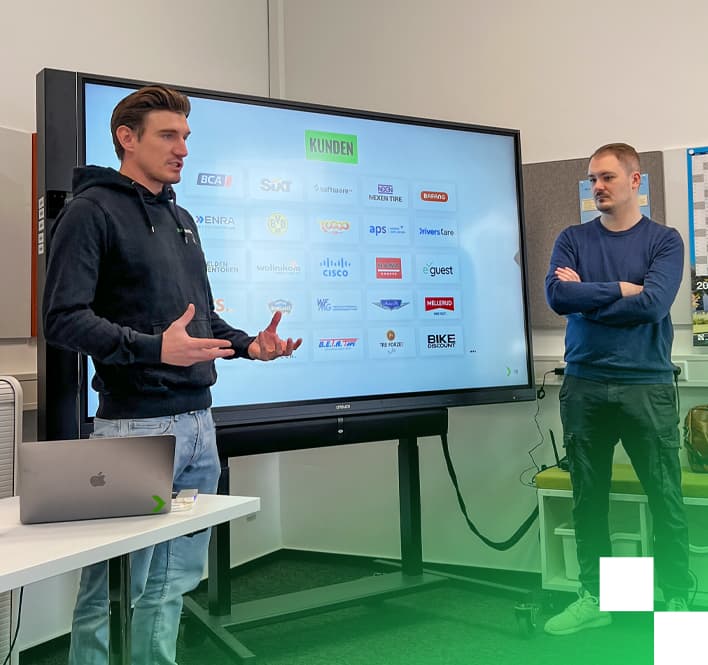
Brands that work with us







Pros and cons of Spryker
Pros
- Spryker is built for complex B2B scenarios, self-service portals and marketplaces.
- Its modular, API-driven architecture cleanly separates commerce logic from frontends.
- As a PaaS, the vendor handles setup, operation and scaling of the infrastructure.
- The Glue API connects storefronts, apps and third-party systems.
Cons
- Spryker requires an experienced PHP development team or a specialised implementation partner.
- For smaller shops with standard requirements, project and operating effort is usually too high.
- The ecosystem of agencies and ready-made extensions is smaller than Shopware's.
- Operation is tied to the vendor's PaaS model.
Is Spryker right for you?
A good fit if …
- You already use Spryker and need support with integrations or frontends.
- You are building a B2B portal or marketplace connected to many systems.
- You want a neutral comparison of Spryker and Shopware 6 before choosing a platform.
- Your in-house team needs reinforcement for API integrations or code reviews.
Probably not if …
- You are looking for a certified Spryker solution partner for a complete new implementation.
- You run a small shop with standard requirements.
- You have no development team and want to run the shop without ongoing development.
- You only need hosting or licence advice.
We work withSpryker
Spryker is modular and API-driven. We use that to connect Spryker cleanly with your system landscape and your frontends.
- ERP, PIM and payment integrations via the Glue API
- Headless frontends, portals and apps built on the APIs
- Extensions and modules in the PHP codebase
- Architecture and platform comparison with Shopware 6
Spryker or Shopware 6?
Both suit B2B. Five questions about your project, and you see which way it leans and why. The weighting follows the trade-off table below.
Question 1 of 5
How big is the project?
All trade-offs as a table
When Spryker – and when Shopware 6?
Both platforms suit B2B. Project size, team and operating model make the difference. This is how we weigh it:
| Decision | Lean towards Spryker | Lean towards the alternative |
|---|---|---|
| Project size | Spryker, if you're planning a large B2B project with many systems, countries and individual processes. | Shopware 6, if most requirements are covered by the standard and extensions. |
| Marketplace | Spryker, if a multi-vendor marketplace is at the core of the business model – Spryker ships dedicated marketplace demo shops for this. | Shopware 6, if you sell yourself and only connect marketplaces as additional channels. |
| Team | Spryker, if you can fund an experienced PHP team or a solution partner long term. | Shopware 6, if you work with a smaller team or an agency and want to choose from a larger pool of developers. |
| Operations | Spryker, if infrastructure, scaling and monitoring should sit with the vendor as a PaaS. | Shopware 6, if you want to choose between self-hosting, a hosting provider of your choice and the SaaS option. |
| Cost | Spryker, if licence, PaaS and implementation are in proportion to the revenue the channel is meant to carry. | Shopware 6, if you want to start with lower entry costs and expand features step by step. |
As of October 2026. The table doesn't replace an architecture decision – we make that with you on the actual project.
Spryker compared
Spryker next to technologies of the same category, measured with the same public sources.
| Figure | Spryker | Medusa | OXID eShop | Shopware |
|---|---|---|---|---|
| Stars on GitHub | 39 | 37K | 238 | 3.5K |
| Releases in 12 months | 12 | 37 | 9 | 51 |
| Median between releases | 15 days | 8 days | 27 days | 6 days |
| Latest version | 3.87.1 (14/09/2026) | 2.22.1 (23/10/2026) | 7.6.0 (07/10/2026) | 6.7.15.1 (02/10/2026) |
| Downloads per month | 30K (Packagist) | 748K (npm) | 25K (Packagist) | 266K (Packagist) |
| Active contributors (12 months) | 0 | 169 | 8 | 207 |
| Security advisories (12 months) | 0 | 1 | 0 | 14 |
Sources: GitHub, OSV.dev, Packagist, npm · as of 29/10/2026. Figures are indicators, not a verdict on quality. Go to the pages: Medusa · OXID eShop · Shopware
Composable and headless
Spryker is modular and separates commerce logic from the frontend. Through the Glue API we connect storefronts, portals, apps and third-party systems.
Focus on B2B and marketplaces
Spryker targets mid-sized to large B2B companies, for example in manufacturing, wholesale and spare parts, and offers dedicated demo shops for B2B, B2C and marketplaces.

Run as PaaS
Spryker is delivered as platform-as-a-service: the vendor handles setup, operation and scaling of the infrastructure. Your team focuses on features and integrations.
PHP codebase
Spryker's commerce modules are written in PHP. Extensions are built as code in the project – that requires an experienced development team but gives you plenty of room to shape the platform.

Back up the platform decision
If you are weighing Spryker against Shopware 6, we compare both against your B2B processes, your team and your operating model.

Spryker Data & Insights
All postsWho is Spryker a good fit for?
What is the Spryker Glue API?
Spryker or Shopware 6 – which fits better?
Do you deliver complete Spryker implementations?
Are you an official Spryker partner?
Sources
As of: October 2026
Your edge with Spryker
We are a Shopware and headless agency with experience in API-driven commerce architectures. So you get a platform assessment that doesn't depend on a licence model.
Neutral comparison of Spryker and Shopware 6 for B2B
Experience with headless frontends and API integrations
Clean interfaces instead of point-to-point wiring
An honest view of effort and team requirements
B2B commerce with Spryker or Shopware?
We help with integrations and frontends for Spryker and assess neutrally which platform fits your project.
To E-Commerce DevelopmentReady for your Spryker project?
Let's talk about your requirements – we'll get back to you within one business day with concrete next steps.
What's it about?

Paul Kalisch
Executive Partner
- 30 minutes by video or phone
- You talk directly to a partner, not to sales
- You get the order of steps, risks and rough costs