

Performance Optimization and Scaling

Every second counts: shops that take more than three seconds to load lose a large share of visitors before they've seen a single product.
Performance Optimization That Drives Revenue
Performance optimization is therefore not a nice-to-have — it's a direct revenue lever. We analyze your full stack performance — from database queries and server configuration to frontend rendering — and implement measures with measurable impact. At the same time, we design infrastructure so that scaling becomes an orderly growth process, not an emergency project. Running the infrastructure long-term is covered on our page about Shopware hosting & operations.
The essentials of Performance Optimization and Scaling
- We analyse your full stack performance – database queries, server configuration and frontend rendering – and optimise where the time is genuinely lost.
- We use multi-layer caching: HTTP caching with Varnish or the Shopware HTTP Cache, object caching with Redis and a CDN for static assets each solve a different problem.
- We convert images to WebP and AVIF, eliminate unused JavaScript and CSS, and reach LCP values under 2.5 seconds, even on mobile connections.
- We simulate Black Friday scenarios with load tests along real user paths and fix bottlenecks before real traffic finds them.
- Permanent performance monitoring with synthetic monitoring and RUM data surfaces problems before customers report them.




Real E-Commerce Successes
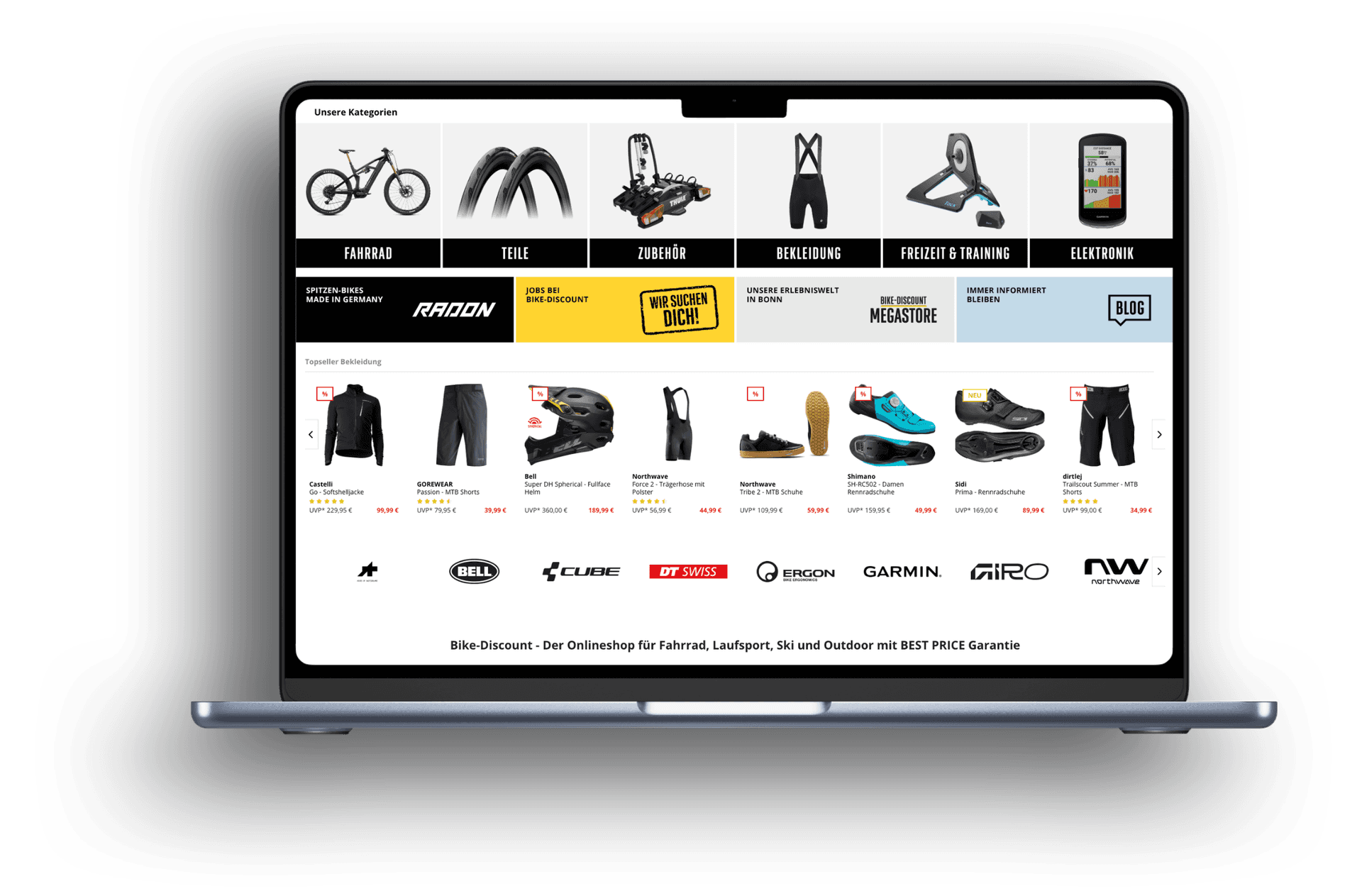


- Your shop slows down or becomes unstable during seasonal campaigns or traffic spikes, and you don't know whether the infrastructure can handle Black Friday.
- Google Search Console shows poor Core Web Vitals for important pages, but you don't know which fixes would make the biggest difference.
- Infrastructure costs are growing disproportionately with the shop's growth because resources are not optimally configured or utilized.
Performance Optimization and Scaling: services in detail
- Load Time OptimisationEvery second of load time costs conversion — that's not a claim, it's measurable reality in any shop with analytics tracking. We run a structured performance audit, identify the biggest load time drivers at frontend and backend level, and implement measures with demonstrable impact: optimised assets, critical rendering path, database tuning. The result is a shop with green Core Web Vitals and measurable improvement.Learn more
- Caching & CDNA well-configured caching stack makes your shop faster and significantly reduces server load — static pages don't hit the database on every request, assets are served from the nearest edge server, and users worldwide experience the same fast result. We implement multi-layer caching with Varnish or Shopware HTTP Cache, object caching with Redis, and CDN integration — coordinated and production-ready configured. If you want us to run the shop afterwards as well, see Shopware hosting & operations.Learn more
- Load Scaling & HostingWhen seasonal promotions, newsletters, or campaigns multiply your traffic, your hosting must keep up — automatically and without manual intervention. We design and implement scalable hosting architectures for Shopware 6: auto-scaling, load balancers, containerised deployments, and forward-looking capacity management. Black Friday is a planned load, not an emergency. How we run the shop long-term afterwards is covered under Shopware hosting & operations.Learn more
Caching as a layered model
No single caching layer solves all performance problems in a complex shop. Only the coordinated combination of HTTP cache, object cache and CDN delivers consistently low load times.
Goal: LCP under 2.5 s
Largest contentful paint loads fast – immediately perceptible to every visitor
CDN – static assets
Images, JS and CSS delivered from an edge node close to the user
Object cache – Redis
Sessions, product data and API responses held in memory
HTTP cache – Varnish / Shopware Cache
Fully rendered pages returned directly without PHP execution
Foundation: database queries & server configuration
Slow queries and misconfigured resources cap the effectiveness of all layers above
Each layer addresses a different problem at a different level of the stack.
From bottleneck to stable scaling
Performance optimization starts with measurement, not assumptions. Our process follows a clear sequence so that measures take effect where the biggest lever is.
Stack analysis
Profiling of database queries, server configuration and frontend rendering – making bottlenecks visible before anything is touched
Prioritization
Measures ranked by impact: LCP, TTFB and server load weighed against effort
Implementation
Caching layers, CDN integration, query optimization and frontend adjustments applied precisely
Load test
Real user paths – search, product page, cart, checkout – simulated under high concurrent load
Monitoring & alerting
Continuous performance monitoring with thresholds so degradation is detected early
Load tests before the event – not as a reaction afterwards.
What matters for Performance Optimization and Scaling
Performance begins with measurement, not guesswork. Before anything is optimised, the whole stack belongs on the bench: database queries, server configuration, frontend rendering. Only once it is clear where the time is genuinely lost is an intervention worthwhile, because the seemingly obvious suspect is often not the most expensive one.
Caching is the most effective measure, but only as a layered model. HTTP caching, object caching with Redis and a CDN for static assets each solve a different problem on a different level. Only the coordinated combination delivers genuinely low load times, while a single layer quickly hits its limits in a complex shop.
Among the frontend metrics, LCP matters most because it correlates most closely with conversion and bounce. On product pages it is usually the product image, exactly the element that shapes the first impression. Win seconds here and you improve not just a number but the perceived speed for every visitor.
Scaling is planning, not reaction. Load tests that simulate real user paths under high concurrent load expose bottlenecks before real traffic finds them. If you only notice on Black Friday that the infrastructure cannot cope, you have already missed the window to act, and the damage is no longer theoretical.
Related goal: More shop revenue
Multi-layer caching is not optional
A single caching layer is not sufficient for a complex e-commerce platform. HTTP caching (Varnish or Shopware HTTP Cache), object caching (Redis for sessions and product data), and a CDN for static assets each solve different performance problems at different layers of the stack — only the combination delivers truly low load times.
LCP is the most measurable UX lever
Largest Contentful Paint measures when the largest visible element on a page finishes loading — for product pages, that's typically the product image. This metric correlates directly with perceived load speed and is the Core Web Vital with the strongest documented relationship to conversion rates and bounce rates.
Load test before the event, not after
Load test scenarios simulate real user paths — product search, product page, cart, checkout — under high concurrent load. Bottlenecks found this way can be fixed before real traffic arrives. Reacting after a Black Friday collapse means the window was already missed.
Fast, even under load
Load time is a direct revenue lever, not a nice-to-have. We analyse in a structured way and make speed measurable via Core Web Vitals — even under peak load.
Measurably faster
Structured performance analysis instead of treating symptoms.
Green Core Web Vitals
LCP under 2.5 seconds for better rankings and conversion.
Load under control
Multi-layer caching and CDN keep the shop fast internationally.
Ready for peaks
Load tests before Black Friday prevent outages during traffic spikes.


How fit is your Shopware shop?
Enter your shop URL – the Shopware audit checks 25+ data points on performance, security, SEO and Shopware setup in 30 seconds.
Audit my shopFrequently asked questions
Your question isn't here? Ask us directly
How do you analyze why our shop is slow?
We start with a multi-stage performance audit: Lighthouse analysis for frontend metrics, database query profiling for backend bottlenecks, server resource utilization under load, and RUM data for the real user perspective. This produces a prioritized list of actions with estimated performance impact for each, so you know which optimizations deliver the biggest return.
What performance benchmarks should a good online shop achieve?
Our target values: Largest Contentful Paint under 2.5 seconds, Cumulative Layout Shift under 0.1, and Time to First Byte under 800 ms. These correspond to Google's Core Web Vitals thresholds for 'Good' and correlate demonstrably with higher conversion rates and better organic rankings.
How do you prepare a shop for traffic spikes like Black Friday?
Through load test simulations with realistic user journeys, we identify bottlenecks in database, caching, and infrastructure before real traffic arrives. We implement auto-scaling, review queue-based processes for asynchronous operations, and create a runbook with specific actions for the case that capacity limits are reached during the event.
Is it worth enabling the Shopware HTTP cache?
In almost all cases, yes — but it requires careful configuration. Dynamic content like shopping carts, prices, and user-specific sections must be correctly excluded from cached pages or handled with ESI (Edge Side Includes). We implement the HTTP cache in a production-ready state with all necessary cache invalidation strategies.
What does performance optimization for a Shopware shop cost?
It depends on the current state and optimization goals. An initial performance audit is often completed in half a day to a full architecture session and gives you a clear overview of action areas and priorities. Implementation costs vary by complexity — from quick frontend optimizations to full infrastructure redesigns.
Last updated on
Ready for your successful online shop?


Related articles from our blog