

Custom Software Development

Off-the-shelf software forces your company into someone else's workflows — custom software mirrors your processes exactly and turns them into a competitive advantage.
In short
Custom software development means an application is planned and built for one company's workflows instead of adapting an off-the-shelf product. You get the source code and the rights and are not tied to a vendor. It pays off when a process is your competitive edge, standard software only covers it with workarounds, or several systems have to work together cleanly.
Custom Software Solutions for Businesses – What We Build
We develop tailored business applications from the first idea to productive operation: thoughtfully architected, cleanly coded, and sustainably maintainable. You don't get an isolated point solution, but a system that grows with your company, fits into your existing IT landscape, and belongs entirely to you — including source code, data, and documentation.
The essentials of custom software development
- We develop business applications that mirror your processes exactly, from the first idea to productive operation.
- We deliberately model only the one process that sets your business apart and keep complexity out, instead of building in every special case.
- In short iterations we deliver usable partial results early, so you steer based on real results rather than assumptions.
- We connect ERP, CRM, inventory management, and third-party systems through clean interfaces so data doesn't have to be maintained twice.
- You own the source code, data, and documentation — we build without proprietary dependencies so another team can take over the software.




Custom software examples: projects from NRW
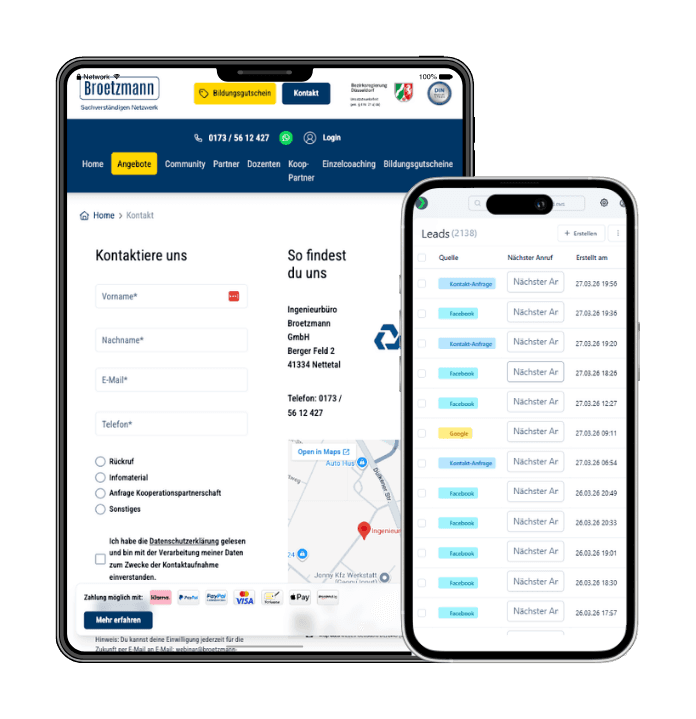
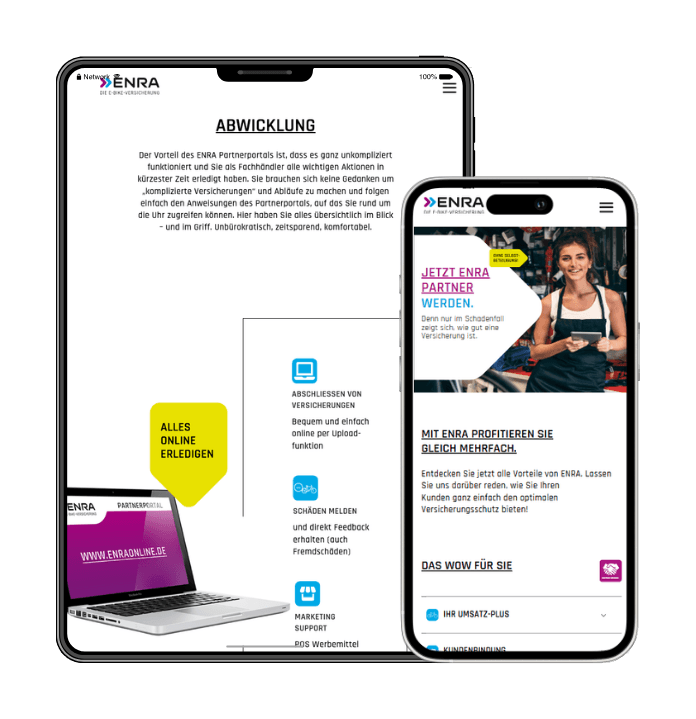

- You've been squeezing your workflows into standard software for years that never quite fits — and you pay for features you don't need while what matters is missing.
- Important processes run on scattered spreadsheets and manual steps that eat time, produce errors, and don't scale with the company.
- Your systems don't talk to each other — data has to be maintained in multiple places, and nobody has a reliable overall view.
Custom Software Development: services in detail
- Web ApplicationsYour business needs more than a website — it needs a web application that reflects your processes, connects to your systems, and is accessible from any device. We build browser-based applications that are complex in logic but intuitive to use: from internal tools and customer portals to transaction-heavy platforms.Learn more
- Industry-specific SoftwareGeneric software doesn't know your industry. Industry software maps its rules exactly. We build tailored applications for companies whose processes, regulations, or data needs no standard product fully covers — from special business applications to systems that meet legal rules.Learn more
- SaaS DevelopmentYou want to offer your product as Software-as-a-Service — with multi-tenancy, scalable infrastructure, and a business model built on recurring revenue. We build SaaS platforms from architecture through billing to the onboarding flow, helping you reach your first paying customer quickly.Learn more
Advantages and disadvantages of custom software
Custom software is not automatically the better choice. Five advantages, four disadvantages or risks – and how to handle each one in the project.
| Advantage or disadvantage | What it means | How to handle it |
|---|---|---|
| Advantage: fits your process exactly | The software follows your workflow instead of forcing your team into someone else's screens. | Model only the core process and leave edge cases out on purpose. |
| Advantage: you own code and rights | You decide on further development, hosting and service providers. | Put the handover of source code, documentation and access into the contract. |
| Advantage: no per-user licence fee | More users or locations do not automatically raise running costs. | Still plan operations and maintenance from the start. |
| Advantage: interfaces as needed | ERP, CRM and third-party systems are connected the way your process needs them. | Define interfaces early in the requirements spec and test them with real data. |
| Advantage: grows with your company | New features follow your priorities, not a vendor's roadmap. | Choose an architecture that allows extensions without a rebuild. |
| Disadvantage: higher upfront investment | Analysis, concept and development cost more at the start than a licence. | Start with a small first release that delivers value quickly. |
| Disadvantage: time to first use | Standard software is available right away, custom software has to be built first. | Develop in sprints and put an early release into productive use. |
| Risk: dependence on the dev team | Without documentation only the team that built the software can continue. | Widely used technologies, ongoing documentation and code handover as a must. |
| Risk: maintenance is on you | No vendor takes care of updates, security and hosting for you. | Agree on a maintenance contract or a clear handover to your in-house IT. |
Whether the advantages win depends on how far your process differs from the market standard.
How much does custom software development cost?
There is no flat price, because every application maps a different process. Five cost drivers determine the effort: functional scope, meaning how many workflows and edge cases the software covers; integrations into ERP, CRM or third-party systems via API integration; roles and permissions when user groups may see different data; compliance such as data protection, audit-proof records or accessibility; and operations with hosting, monitoring and maintenance.
MVP
A first release with the core process and few roles, as a web application or an app. It tests whether the idea holds up in daily work. The smallest of the three project types and the usual starting point.
Business application
An application for one or more departmental processes, with a permission concept and connections to existing systems. With a lot of industry logic it becomes industry software. Clearly more effort than an MVP.
Platform
A system for many user groups, often with tenants, billing and high availability requirements, such as a customer portal or a SaaS product. The most extensive type, because operations and scaling are part of the product.
Fixed price or time and materials?
A fixed price fits when scope and interfaces are described in a requirements spec. Time and materials fits when requirements only become clear during the project. A common route: a fixed price for analysis and the first release, then sprints on time and materials.
The project calculator gives you a first estimate for your project: it calculates a range from your answers.
From idea to productive system
Custom software projects rarely fail because of the code — they fail because false assumptions are held onto for too long. Our approach breaks development into usable increments so you can steer early rather than correct at the end.
Process analysis & scope
We model the core process that drives real competitive advantage — and deliberately define what will not be built.
Architecture & technology decision
Right stack, clear interface definition to existing ERP and CRM systems, data ownership secured from the start.
Iterative development
Short loops with usable increments: your team tests real software, not PowerPoint slides.
Integration & quality assurance
Automated tests lock down behaviour; third-party integrations are validated under real-world conditions.
Go-live & handover
Source code, documentation, and operational knowledge belong to you — no vendor lock-in, full ability to evolve.
Each phase delivers a testable result; insights feed directly into the next iteration.
Off-the-shelf vs. custom software
Off-the-shelf software looks cheaper at first glance. Whether it stays that way depends on how far your core process diverges from the covered standard scope.
| Off-the-shelf | Custom software | |
|---|---|---|
| Process coverage | Generic – workflows must be adapted | Modelled exactly around your workflows |
| Ownership & independence | ||
| Adaptability | Constrained by vendor roadmap | Fully under your control |
| Licence & workaround costs | Ongoing, hard to forecast | One-time development investment |
| Integration into IT landscape | Standard interfaces, gaps via middleware | Interfaces built to spec |
| Makes sense when … | Process = market standard | Process = competitive advantage |
The right choice depends on the differentiation potential of the process, not the list price.
What matters in custom software development
What makes custom software succeed is decided less in the code than in the discipline of keeping complexity out. Good custom software models exactly the one process that sets your business apart and deliberately leaves everything else aside. Build in every special case and every maybe-someday instead, and you end up with a system that is expensive to build and maintain yet still delivers no clear advantage.
Equally decisive is how close development stays to the people who will actually use the software. A system built without real involvement from the business almost never hits the mark. Short loops with usable interim versions stop you from sinking months into a wrong assumption and turn vague ideas into testable reality you can steer by.
Solid execution shows in the invisible parts: tests that lock down behaviour, documentation that does not live in one person's head, and a codebase a new developer can learn in days rather than weeks. That is what separates an investment that lasts for years from one that becomes a millstone after the first staff change. Owning source code and data is only worth something if someone else can genuinely keep working with it. After go-live we keep the application stable through application management on request – with monitoring, updates and agreed response times.
Standard isn't always cheaper
Standard software seems cheaper at first, but customizations, workarounds, and license fees add up. When a process is your competitive advantage, custom software can be more economical over the years — because it fits exactly and forces no foreign workflows.
Usable results early
Iterative development delivers usable stages in months instead of at the end of the project. You steer based on real results rather than assumptions — drastically lowering the risk of developing past the actual need.
The software belongs to you
With custom development you receive source code, data, and documentation. This protects you from vendor lock-in and ensures you can switch providers or continue development internally without starting from scratch.
Software that fits exactly
Off-the-shelf software forces you into someone else's workflows — custom software turns your processes into an advantage. We deliver iteratively and show value early.
Exactly your processes
Software that maps your workflows instead of adapting you.
Measurably less effort
Automated routine tasks save time and cut errors.
Future-proof
A technology stack that stays maintainable long term.
Early value
Iterative delivery minimises the risk of misdevelopment.

Software development from Mönchengladbach and Düsseldorf
Our headquarters are in Mönchengladbach, with a second office in Düsseldorf. We like to hold analysis workshops on site with you in NRW, and development runs with fixed contacts for clients across Germany. Read more about our locations and regional projects at our digital agency Mönchengladbach and digital agency Düsseldorf.
What will your software or app cost?
Answer a few questions about your project – the Project Calculator shows a first range for cost and duration and the biggest effort drivers.
Start the Project CalculatorFrequently asked questions
Your question isn't here? Ask us directly
Standard software or custom software – how to decide?
What matters is the differentiation potential of the process, not the list price. If your process matches the market standard, standard software is usually the right choice: cheaper, available immediately, with standard interfaces. Custom software is the better fit where the process is your competitive advantage, standard solutions would force you into foreign workflows, and workarounds, customizations and license fees add up over the years. We tell you honestly when a standard solution is sufficient, instead of selling you a custom build.
What does custom software development cost?
Smaller line-of-business applications typically start in the mid five-figure range; extensive business applications with ERP integration are in the six-figure range. The decisive factors are process scope, the number of interfaces and the effort for data migration. We recommend starting with a focused first stage that creates value quickly, rather than building everything at once. A fixed price is set after process analysis and requirements specification.
How long does a custom software project take?
That depends on scope and depth of integration. After process analysis and the architecture decision we develop in short iterations: a first usable increment is ready within a few weeks depending on scope, the complete system with all interfaces takes several months. So you see value early and can steer before the overall system is finished.
Who owns the finished software — does vendor lock-in arise?
You own everything: source code, data, and documentation. We deliberately build so that another team could take over, and we avoid proprietary dependencies. Vendor lock-in is not a business model for us, but a risk we actively rule out.
Can you connect custom software to our existing systems?
Yes, this is one of our focus areas. We connect existing ERP, CRM, inventory management, and third-party systems via APIs and interfaces so data doesn't have to be maintained twice. Clean integration is often the real lever: it connects isolated solutions into a continuous process.
How does a custom software project run with you?
In four steps: first we clarify in a requirements analysis which processes the software has to cover – with a requirements specification where needed. Then comes a concept with architecture and a prototype you can try early. Development runs in sprints with testable increments, so you can steer at any time. After go-live we support operations and further development – with fixed contacts instead of ticket-system anonymity.
Last updated on
READY FOR SOFTWARE BUILT AROUND YOUR BUSINESS?


Related articles from our blog