

Process Analysis & AI Strategy
Workshop + analysis

We put numbers on which of your processes pay off with AI – and which do not: volume data, effort-benefit calculation, pilot proposal
- Format
- On-site, remote or analysis program
- Duration
- 1 workshop day, analysis phase by scope
- Participants
- Ideally 4–10 decision-makers & subject leads
- Language
- German or English
- Level
- No AI experience required
- Completion
- Written analysis report + prioritized roadmap
Process Analysis Before AI Investment
Before you invest in AI, you need to know where it will actually make a difference. We systematically examine your business processes — step by step, department by department — and identify the points where automation and intelligent decision support offer the greatest leverage. The result is not a deck full of buzzwords but a concrete, prioritized AI roadmap that fits your budget, your infrastructure, and your goals. You get a defensible ranking of which next step promises the highest return. And waiting is not neutral: a single process with 20 minutes of rework, 40 times a week, ties up around 70 person-hours per month – they just never show up in any budget until someone puts a number on them.
The essentials of Process Analysis & AI Strategy
- Systematic analysis of your business processes: frequency, time spent and error sources – captured with your subject leads in the workshop, measured on real transactions in the analysis program.
- Use-case scoring separates what is technically possible from what pays off economically.
- The result is a prioritized AI roadmap with an effort-benefit estimate per use case – matching budget and system landscape.
- Format: workshop on-site or remote, optionally with a multi-week analysis phase in your departments.
- Outcome: a written analysis report as a decision paper for management and IT – all participants additionally receive the nextlevels “AI Adoption Specialist” certificate.




Software & automation in practice

Contents
No buzzword deck: we work on your real processes and numbers. The workshop structures the analysis into four modules – depending on scope, a deeper analysis phase in your departments follows.
Mapping processes & volumes
- Walking through your workflows step by step – department by department
- Quantifying frequency, minutes spent, queries and rework per process
- Separating the loudest complaints from the biggest lever: numbers over gut feeling
- Honestly capturing exception rates – edge cases decide the business case
- Typical candidates in mid-sized companies: drafting quotes from inquiry emails, invoice intake checks, complaints handling, order entry into the ERP
Use-case scoring & ROI
- Cleanly separating what is technically possible from what pays off
- Effort-benefit estimate per use case: when does implementation earn back its cost?
- Identifying quick wins that deliver first results within weeks
- Deciding deliberately which edge cases stay with people
System landscape & data availability
- Assessing ERP, CRM and interfaces – whether SAP, proAlpha, weclapp or a homegrown system: what can be connected sensibly?
- Data availability and master-data quality as an equal prioritization axis
- Weighing integration effort alongside the business benefit
- Spotting silo risks early, before a quick win blocks later stages
Roadmap & pilot definition
- A phased implementation plan matching budget and capacity
- Scoping the first pilot use case cleanly: goal, scope, acceptance criteria
- Defining measurable KPIs per phase – success is calculated, not claimed
- A decision paper for management and IT in one document
- The roadmap does not disappear into a drawer: on request we implement the first pilot ourselves – from API integration to the running workflow
Your benefits
The outcome is on paper at the end – as a prioritized roadmap, not a slide deck:
- Clear priorities: AI only where it delivers real ROI
- Structured inventory of your automatable core processes
- Phased implementation plan matching budget and capacity
- Minimizes the risk of wasted investment through solid potential analysis
- Single roadmap as decision basis for leadership and IT
- Quick wins calculated on real transaction figures: frequency times minutes times exception rate – whatever fails the business case is dropped from the roadmap
Who it's for
For everyone who decides on or owns AI investments – no technical background required. We adapt depth and language to the group. We are strongest where commerce meets processes: e-commerce, wholesale and B2B sales with ERP, inventory management and shop systems – system landscapes we have been integrating ourselves for years.
- Management & owners
- IT leadership & CIO
- COO & operations
- Process owners & team leads
- Digitalization officers
- Controlling & finance
Methods
Analysis instead of lecture: most of the time belongs to your processes, numbers and systems. Your effort stays predictable: one structured interview per department plus the joint workshop day – no further preparation needed.
- Structured interviews with the departments running the processes every day
- Volume assessment on real transactions: how often, how long, where it gets stuck
- Joint scoring workshop: evaluating and prioritizing use cases
- System landscape review with your IT – interfaces, data quality, hosting
- We analyze processes, not people: results are aggregated at process level, never reported as individual performance – on request we align the approach with your works council beforehand
- Final presentation with roadmap handover and a concrete next step
From process mapping to a prioritised AI roadmap
A sound AI strategy does not emerge from a whiteboard session — it comes from systematic stocktaking. This sequence ensures the final roadmap fits your infrastructure and budget, not the next trending technology.
Process mapping
Department by department, running processes are documented: frequency, systems involved, manual steps, queries, and rework.
Volume & time assessment
Every process receives a quantitative profile — how often it runs, how long it takes, how high the exception rate is. Hidden effort only becomes visible at this stage.
Technical feasibility check
API availability, data quality, and system compatibility are matched against automation candidates. What is technically possible is separated from what actually pays off.
Potential prioritisation
Each use case is rated by business value, integration effort, and data availability. Anything that does not survive the business case is removed from the list.
AI roadmap & quick-win plan
The output is a phased roadmap: early quick wins that do not block later build-out stages, and a scalable data layer for all subsequent implementations.
Each phase delivers a concrete artefact that prepares the next one.
Prioritisation factors for AI use cases
Not every process justifies automation. These factors together determine which use case makes it onto the roadmap — and in which order.
- Process frequencyHigh repetition multiplies every unit of saved effort
- Manual time per runMinutes per instance × frequency = hidden capacity tied up
- Error and rework rateError-prone processes generate double the workload and escalations
- Data availability & API maturityNo clean data or interface means no reliable automation approach
- Exception rateMany edge cases per run erode the gains from automating the standard flow
- Integration effortOrganically grown system landscapes significantly raise implementation cost
Relative Weight
Weights reflect relative influence on the business case, not absolute metrics.
Certificate
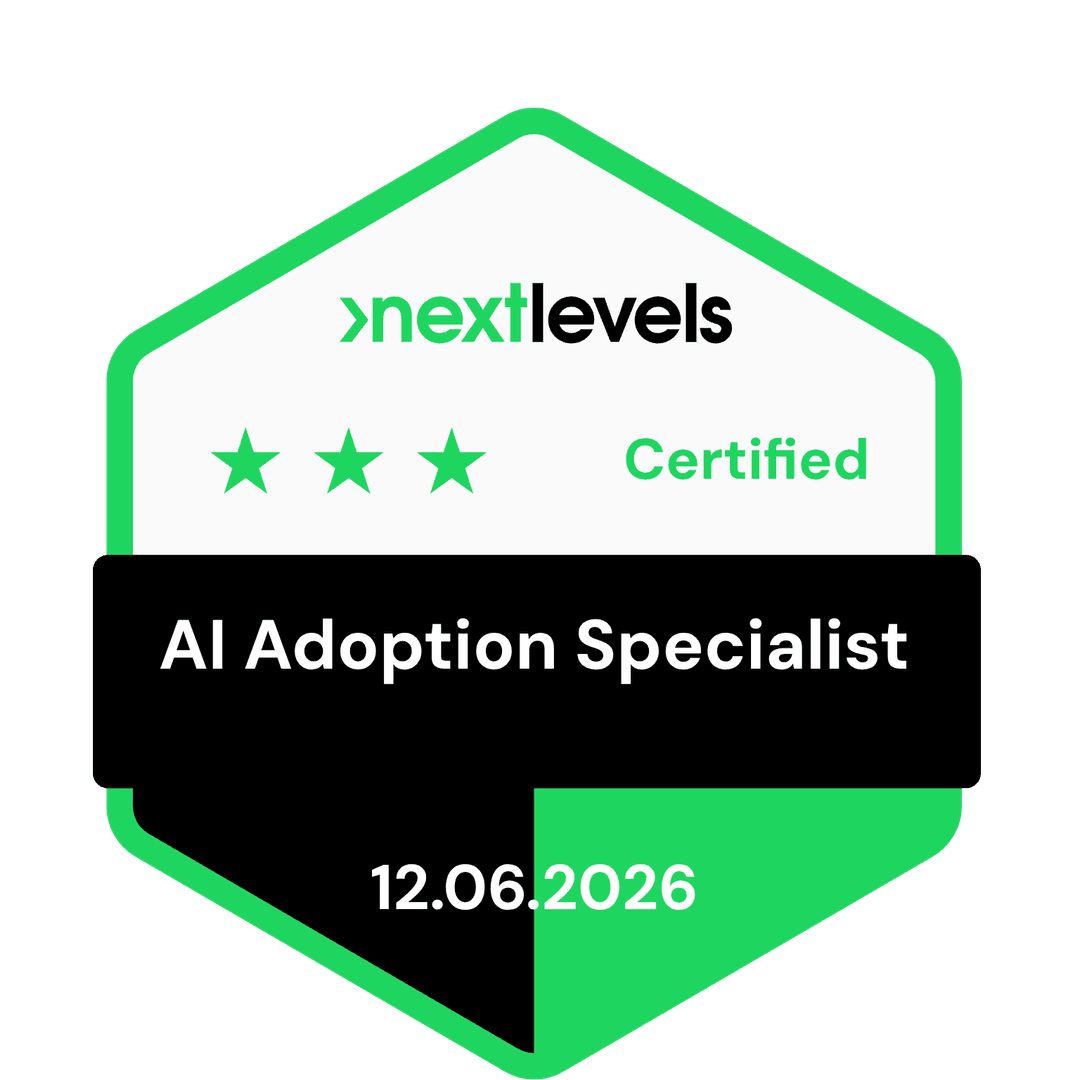
nextlevels Certified: AI Adoption Specialist
Participants who complete the workshop program receive a digital certificate. It attests the ability to assess AI potential in their own company systematically: collecting volume data, scoring use cases and building a sound roadmap. The certificate is issued by nextlevels and is not an accredited certification – it documents the assessment work completed in the program.
- Attests applied assessment work on your own processes, not mere attendance
- Usable as a building block for your training documentation under Article 4 EU AI Act
- Personalized with name and workshop date – shareable as a digital badge
Formats & booking
Three paths to the roadmap – choose the entry point that fits your company. After that, you decide: implement the pilot with us, carry the roadmap forward in-house, or put it out to tender – the roadmap is written for exactly that.
On-site
Workshop at your place – seeing processes where they run.
- We come to you – or you visit us in Mönchengladbach
- Full-day format with all relevant departments at one table
- Ideal for the first assessment: clarifying questions right at the process
Remote
Interviews and scoring sessions – without travel costs.
- Modular blocks of 2–4 hours, spread over one to two weeks
- Systems and documents are reviewed directly in the call
- Distributed teams: process capture via screen sharing and asynchronous volume-data collection
Analysis program
Workshop plus a multi-week deep analysis in your departments.
- Volume data is collected per department instead of estimated in the workshop
- System landscape and data availability examined in detail
- Roadmap with pilot definition and KPIs as the closing artifact
A focused workshop or process analysis typically sits in the low four-digit range – after a short call you receive a concrete quote.
Frequently asked questions
Your question isn't here? Ask us directly
How does your AI process analysis work in practice?
We start with a structured kick-off to capture your goals and pain points. This is followed by interviews with relevant employees, detailed process mapping, and a technical inventory of your system landscape. The output is a written analysis report with prioritized AI use cases and a concrete roadmap — typically delivered within two to four weeks.
What company size benefits from an AI strategy?
A structured AI strategy pays off from the moment you have multiple employees spending time on recurring tasks. Whether ten or a thousand staff — what matters is not the size: every month without volume figures is a month in which those process costs keep running unmeasured.
When is the right time for the analysis?
Before budget planning. The analysis takes two to four weeks and delivers the numbers that anchor AI line items in the budget round – if you plan in autumn, you start before the summer break. A roadmap that is only finished after the budget round waits a full budget year for its money. Independently of that, the AI literacy obligation under Article 4 of the EU AI Act has applied since February 2025 to companies using AI systems.
How is your AI consulting different from traditional management consulting?
We are an implementation partner, not just advisors. What we recommend, we can build directly — from API integrations and AI chatbots to automated workflows. This closes the classic gap between strategy slides and lived practice. The roadmap itself is vendor-neutral and tender-ready: you can implement every recommendation with us, with another provider, or in-house – there is no implementation lock-in.
How long before the first results are visible?
Quick wins — small, clearly defined automations — are often live within a few weeks. More complex projects such as a full AI integration into existing system landscapes take longer. Our goal is always to show early impact quickly while building larger initiatives in parallel.
What data do you need from us for the process analysis?
Essentially: process descriptions or documentation, access to key people from the relevant departments, and a rough overview of your IT system landscape. Anything not yet documented we work out together in workshops — that is not an obstacle but part of the process.
How do you handle our data and documents?
Confidentially. On request we sign an NDA before the kick-off, and as soon as personal data is processed we conclude a data processing agreement under Art. 28 GDPR. Your process data and documents are never used to train AI models and are deleted after the project on request.
Does the workshop count as an AI literacy measure under Art. 4 EU AI Act?
The workshop can be documented as a training measure: you receive an agenda with learning content, the hours covered, a participant list and personalized records for your training documentation. Whether that fully satisfies Art. 4 EU AI Act in your context depends on the participants' roles and how AI is used – we tell you upfront, honestly, what the workshop covers and what it does not.
How is this different from a standard AI seminar (chamber of commerce, public programs)?
Seminars teach general knowledge on example cases – a sensible, often cheaper choice if you first want orientation. Here we work on your own processes and numbers: the outcome is not a slide set about AI in general but an analysis report on your concrete use cases with an effort-benefit assessment. If you need to prepare an investment decision, you need the analysis, not a seminar.
Isn't ChatGPT enough to get started?
ChatGPT answers prompts – it knows neither your volume figures nor your interfaces. An internal workshop with AI tools produces ideas, but no defensible sequence: which process pays off first, what connecting it to the ERP costs, which exception rate kills the business case. Those numbers are exactly what the analysis delivers – an investment decision, not a chat transcript.
Last updated on
IN 30 MINUTES WE'LL TELL YOU WHETHER AN ANALYSIS PAYS OFF FOR YOU – AND IF IT DOESN'T, WE'LL SAY SO.
No sales pitch: in the intro call we clarify which of your processes are candidates and whether the workshop or the analysis program fits. Afterwards you receive a concrete written quote.


Related articles from our blog