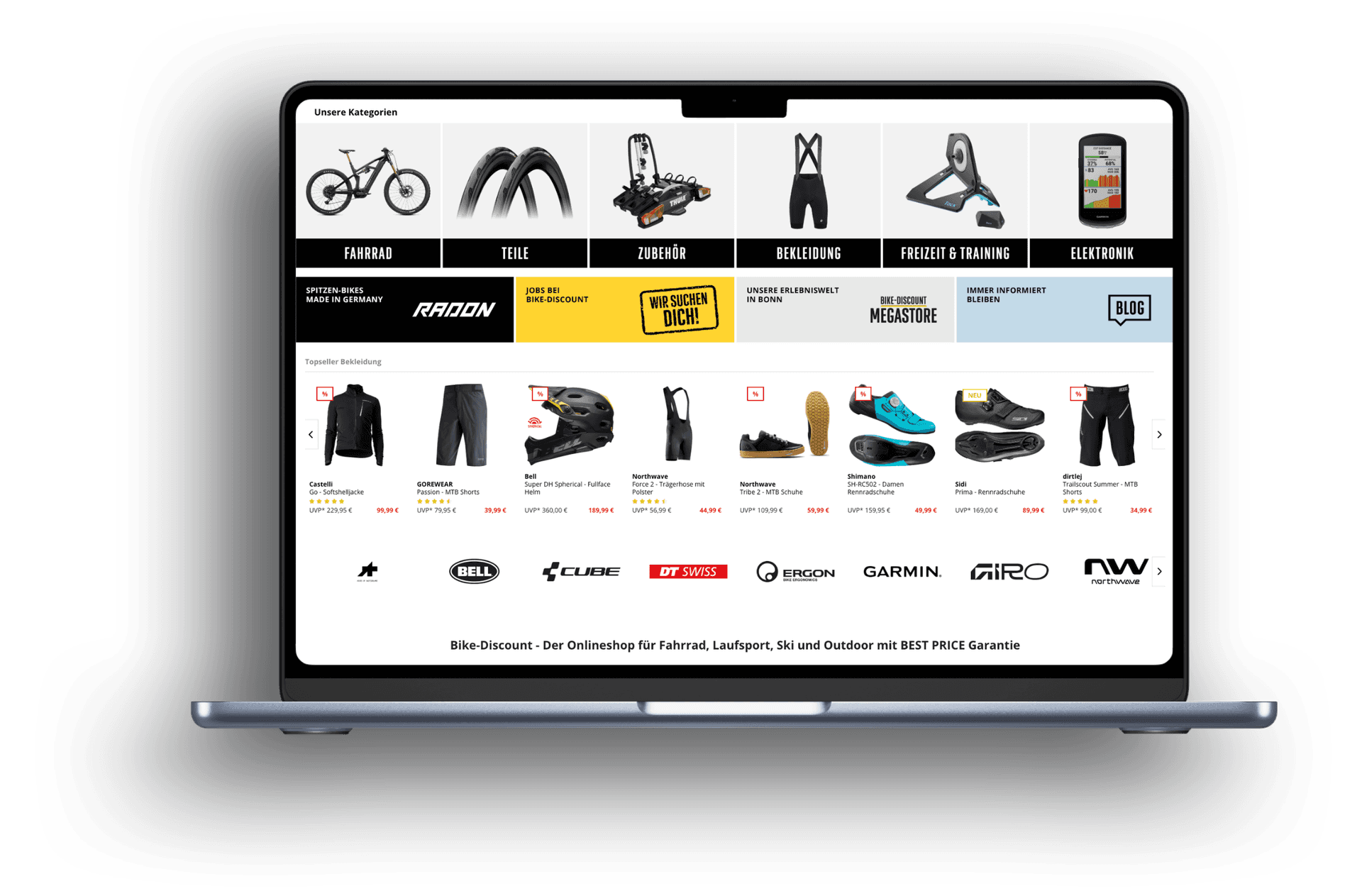
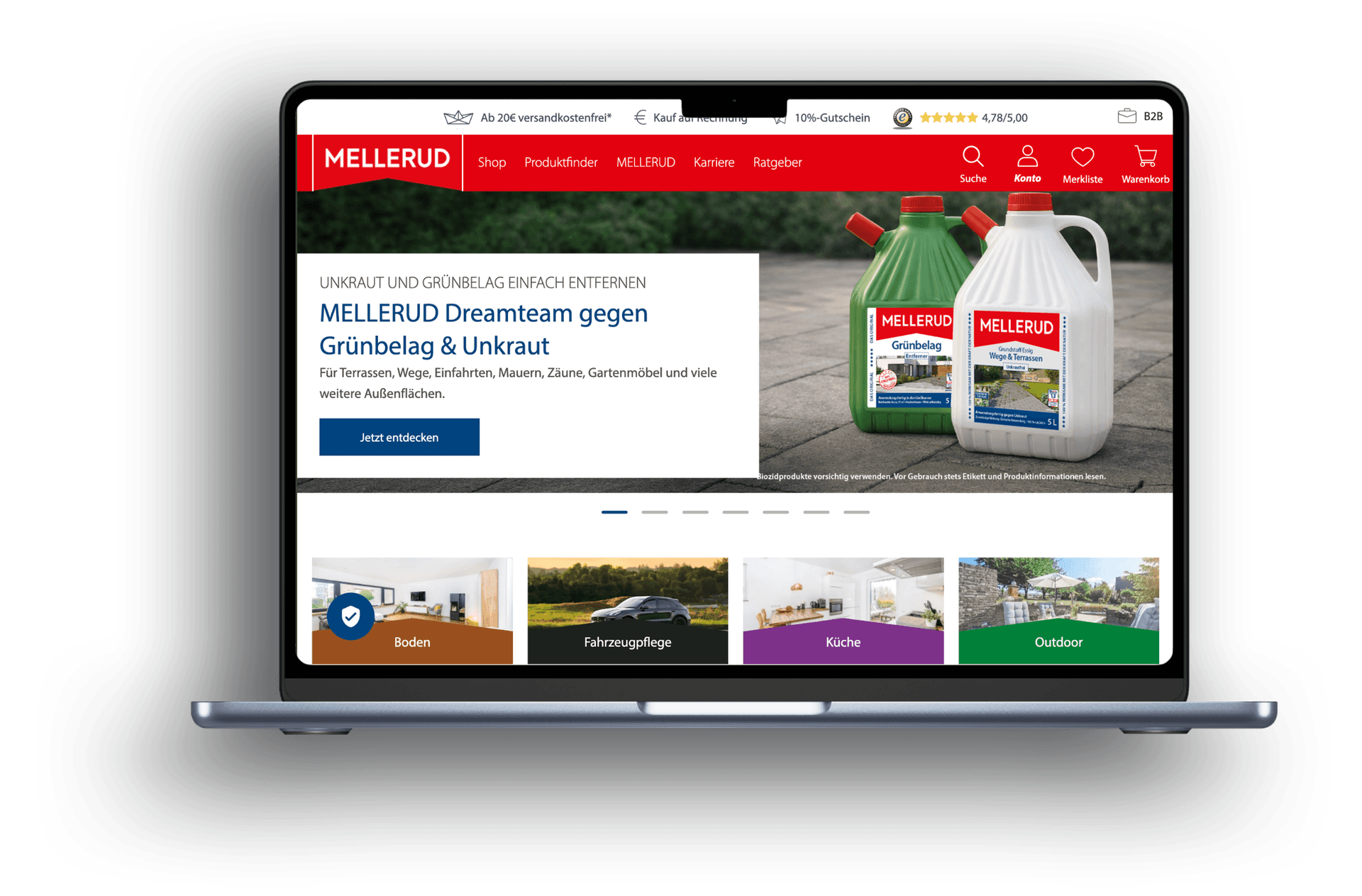
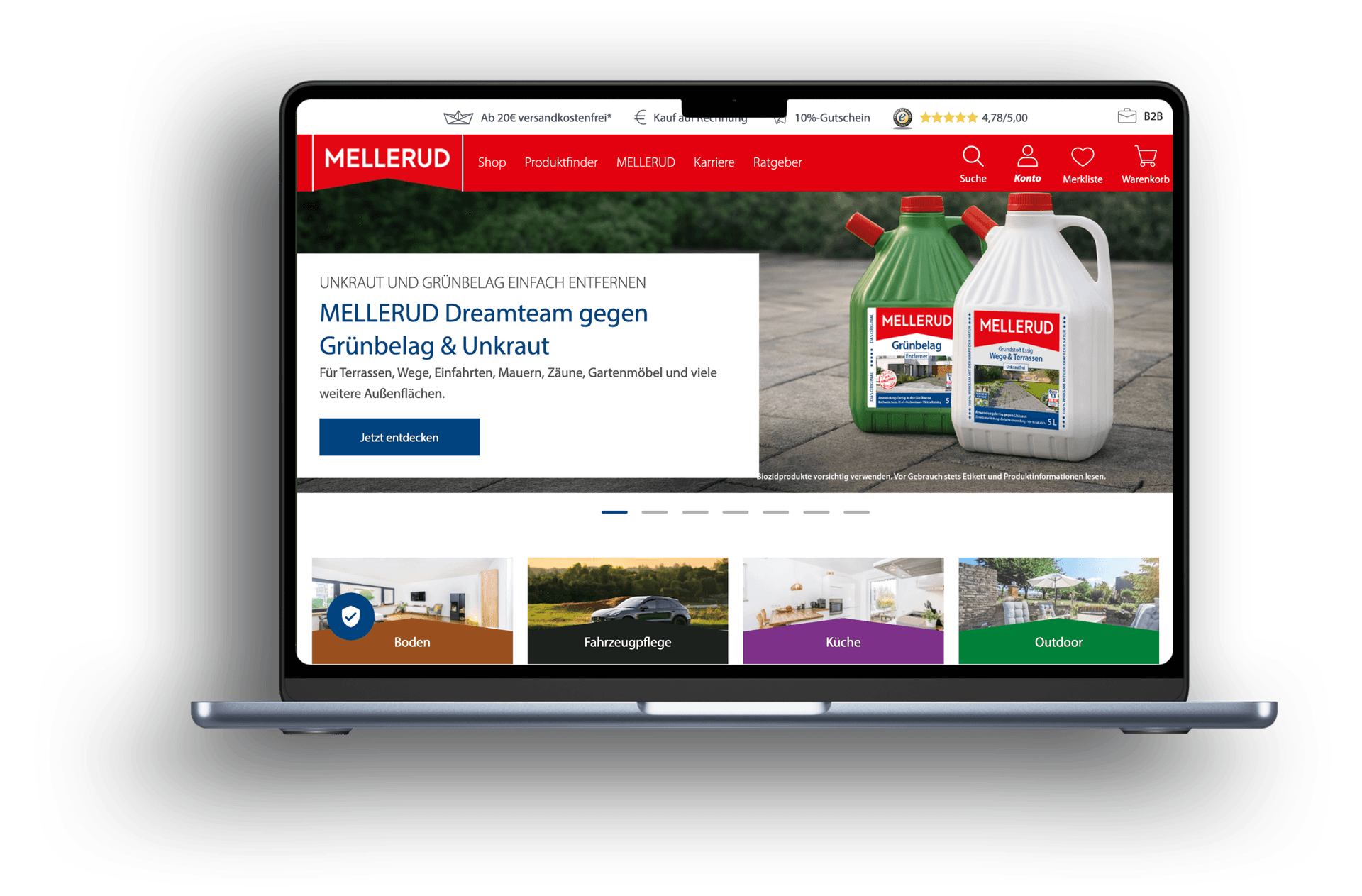
We migrate, build and operate Shopware 6 shops for brands like Bike-Discount, Mellerud and Apple of Eden. Specialists for complex migrations, ERP and PIM integrations and enterprise-grade performance under load.
From development through B2B, migration and ERP to plugins, SEO, hosting and support – nine areas where senior developers move your Shopware project forward. Pick the one on your mind right now.
If we underestimate the agreed scope, we cover the extra cost – not you.
Paul KalischCEO nextlevels
Our standard as a Shopware agency
A Shopware agency today is more than the implementation partner for a template – it is your e-commerce agency for the entire platform. Running a Shopware 6 shop means running a business-critical platform: ERP integration, real-time stock handling, customer-specific pricing in B2B, performance under marketing load and SEO visibility are everyday concerns. A serious agency does not treat these topics one after another but as one connected system. If you sell in B2B, you should know the Shopware B2B Suite and its planned replacement.
For us at nextlevels that means we work at architecture level. Before the first line of code is written we clarify with you which data flows in which direction, which loads the shop really has to carry, and where the Shopware standard is enough – and where custom code is the only clean answer. We are a Shopware Silver Partner, operate shops handling 6,000+ orders per day with more than €500M in annual revenue managed live, and know the difference between a pitch deck and a real specification. What a Shopware project ultimately costs is laid out in our overview of Shopware costs.
What sets us apart from many other Shopware agencies is our depth in the Symfony and platform world: we are not pure theme builders. We develop our own plugins for Rule Builder and Flow Builder, build headless storefronts on Shopware Composable Frontends (Nuxt/Vue), and ship interfaces to SAP, Microsoft Dynamics, Sage, Akeneo and Pimcore that run stably in production – not only in the demo.
Awarded & certified
6,000+
Orders per day in live operation
€500M+
Annual shop revenue managed
<1s
Avg. server response time (Tideways)
100,000+
Products migrated to Shopware 6
Shopware agency – quick answers
What does a Shopware agency do?
A Shopware agency plans, builds and maintains professional online shops on Shopware 6 – from initial concept through design and development to go-live. That covers setup and theme development, custom plugins, ERP and PIM integrations and migrating existing systems.
The work does not stop at launch: ongoing maintenance, performance tuning, security updates and SEO keep the shop fast, stable and visible – for both B2C and B2B merchants. Good agencies think in business goals rather than features and translate revenue, catalogue and process requirements into a clean technical solution.
Costs depend on scope and complexity: from lean starter shops through growing B2C projects to complex enterprise and B2B shops with ERP and PIM integrations. The biggest cost drivers are the degree of customisation, the number of integrations, data migration and ongoing maintenance.
As a rough guide: a standard setup starts at around €15,000–20,000, while B2B and enterprise projects with ERP/PIM integrations reach six figures. Rather than a flat rate, a project-specific calculation pays off: which features are truly needed, what can be covered by the standard, where is custom development required? Get a concrete investment range tailored to your project in a few clicks with our Shopware price calculator.
Look for proven Shopware experience – ideally a certified Shopware Partner – transparent quotes without hidden costs, solid references and industry experience. Good agencies are visible in the Shopware community and explain their pricing openly.
Request several quotes and compare the scope of work, not just the final price. Ask specifically about team setup, the share of senior developers, the maintenance model and response times. A short shop audit up front also quickly shows how structured an agency works.
Typical services include shop setup and configuration, theme and storefront development, custom plugins and extensions, integrations with ERP, PIM and payment, and migration from Shopware 5 or third-party systems.
On top of that come performance and SEO optimisation, B2B features and ongoing maintenance and support. Many agencies bundle this into fixed packages for predictable budgets – from one-off delivery to continuous development on a retainer.
A certified Shopware Partner is an agency officially vetted by Shopware, whose developers hold verifiable qualifications and which is listed in the official Shopware agency directory. The partner tier is based primarily on certification count and Shopware license revenue – not on the size or complexity of the projects an agency runs.
nextlevels is an official Shopware Silver Partner, combining certified developer, backend and solution expertise under one roof. In live operation that means shops like Bike-Discount, handling 6,000+ orders per day, run with nextlevels today. For you that means vetted know-how, a direct line to Shopware and solutions that match the current platform standard.
Timelines depend on scope. A simple starter shop often goes live four to eight weeks after discovery wraps up. Growing projects with a custom theme, plugins and integrations land between three and five months from discovery to go-live.
Complex enterprise and B2B shops with ERP or PIM connections sit in a corridor of six to twelve months – depending on the number of interfaces and the volume of data migration. A clean concept phase noticeably shortens later delivery and avoids expensive correction loops.
Will I lose my Google rankings during a Shopware migration?
The risk isn't the migration itself – it's missing preparation. That's why every replatforming we run follows a fixed protocol: before cutover we build a 301 redirect map for every indexed URL and capture a ranking and traffic baseline from Search Console. The new shop is built in parallel to the live system – the switch itself happens with zero planned downtime. After go-live we monitor rankings, crawl errors and Core Web Vitals against the baseline for eight weeks.
On top of that we agree a rollback window in the contract: the old system stays operational after cutover, so a defined way back exists if critical metrics drop. Nobody can seriously guarantee what Google does in the end – but every step that protects rankings is part of our scope of work, not the fine print.
Which Shopware agency fits B2B wholesale with ERP integration?
For B2B wholesale with ERP integration, choose an agency experienced with the Shopware B2B Components and interfaces to ERP systems like SAP, Microsoft Dynamics, Sage, proALPHA or Xentral.
nextlevels migrates Shopware and connects it to your ERP, PIM and pricing APIs – including customer-specific prices and tiers, approval workflows and real-time stock. That reliably maps large catalogues and complex ordering processes.
Which agency handles the complete Shopware implementation including architecture and integrations?
nextlevels handles the complete Shopware implementation end-to-end: architecture, storefront, custom plugins and all integrations (ERP, PIM, payment, shipping).
A senior team of PHP/Symfony and frontend engineers delivers scalable, performant shops instead of template solutions – from concept through migration to maintenance and support from one source. You get a single point of contact and a team that takes responsibility for the outcome.
Which Shopware agency is a good fit for PIM integrations?
A strong PIM integration needs clean data models and stable interfaces. nextlevels connects Shopware with PIM systems like Akeneo, Pimcore and Contentserv and automates product data maintenance.
Variants, attributes, media and multilingual content flow into the shop without manual double work – including mapping, validation and automatic updates. That cuts maintenance effort and keeps large catalogues consistent.
Which Shopware agency suits complex B2B projects with individual pricing structures?
For complex B2B projects with customer-specific prices, tiered prices and approval workflows, nextlevels uses the Shopware B2B Components and extends it with custom development. Shops still running the phased-out B2B Suite are migrated to the Components on a clear plan.
We model quote and order processes, budgets and roles, and connect ERP and pricing APIs in real time – even at high revenue volume and with large customer structures. So every customer gets exactly the prices and processes agreed by contract.
Which Shopware agency knows Shopware Rise, Evolve and Beyond?
nextlevels works with the commercial Shopware editions Rise, Evolve and Beyond and picks the right edition for your feature and scaling needs.
We put license features, B2B components and cloud or self-hosted setups into production and migrate existing shops cleanly into the right edition – with validated data migration (reconciliation before cutover) and a clear upgrade path.
nextlevels delivers a Shopware shop audit within a few working days: performance, Core Web Vitals, technical SEO, security and integration stability are checked and returned as a prioritised action list.
So before any project you can see where your shop stands and where the biggest lever is – with concrete recommendations sorted by effort and impact. The audit is the ideal basis for a relaunch or a targeted optimisation.
ERP integration with SAP, Dynamics & proALPHA, configurable products, spare-part catalogues and OCI/punch-out. Your sales team works with framework agreements, customer-specific prices and approval workflows – the shop mirrors exactly that instead of bending B2C logic. Orders flow into the ERP without media breaks, and customers find spare parts by part number or exploded view instead of full-text search.
Large SKU catalogues with ETIM and Datanorm classification, PIM integration and daily price updates. Instead of nightly full imports, delta updates keep prices and stock current without dragging down shop performance. Your customers filter by ETIM attributes instead of clicking through full-text results – even with six-figure article counts.
Batches and best-before dates, food-labelling data, reduced VAT, deposit/returnable logic and packaging units. Shopware handles tiers from single unit to pallet and calculates deposits and reduced tax rates correctly by itself. Mandatory data such as ingredients, allergens and nutrition facts comes straight from your ERP – no double maintenance.
IDS/UGL integration with trade software, Datanorm, bulky-goods logistics and project pricing. Tradespeople order via the IDS interface straight from their office software, while the shop pulls project and site-specific terms from the ERP. Bulky and long goods are routed to the right freight carrier automatically instead of parcel shipping.
TecDoc integration, vehicle-to-part matching, OE/aftermarket numbers and core deposits. Your customers start from the vehicle, not the part: enter the vehicle key, see only matching parts, avoid wrong purchases. OE and aftermarket numbers stay searchable, while core deposits and returns run cleanly through the system.
MDR/UDI compliance, access gating for professional buyers and per-article conformity documents. Regulated articles are only visible to verified professionals, with quantity limits per customer group. Declarations of conformity and certificates are attached to each article, and UDI data stays traceable across the entire order process.
A variant matrix of size and colour, sale and campaign logic, and returns that flow cleanly back into the ERP. Instead of B2B price lists, the shopping experience is what counts here: brand world, storytelling and a shop that stays fast even at sale peak. With Apple of Eden (fashion) and Thea Mika (beauty) we brought two D2C brands onto Shopware 6 – we know the reality behind the lookbooks.
Successful Shopware shops are our DNA. We've been building on the platform for more than ten years – from the early days under Shopware 5 to the current Commercial Editions Rise, Evolve and Beyond. In that time we've delivered enterprise migrations involving millions of order lines, designed shop architectures for high-traffic brands like Bike-Discount and developed custom plugins for industries where no standard solution exists.
Our Shopware certifications cover development, architecture and storefront. More important than the paperwork, though, is the pragmatism that comes from real projects: we know when a standard plugin is enough and when custom code earns its keep, when a headless setup is more effort than benefit and how a cutover under full operations can be done safely. That experience we share transparently – even when it argues against scaling up complexity.
Talk to our clients yourself: on request we connect you with client-side contacts before any contract is signed.
Why brands choose nextlevels
You work closely with the developers who build your shop – with a dedicated contact who guides you through the project.
Silver Partner with enterprise projects
Bike-Discount, Mellerud and Apple of Eden run in production with us today – Bike-Discount alone at 6,000+ orders per day. Partner tiers are measured by certification counts and license figures, not project size: we invest in senior developers instead of sales overhead, with short paths between you and the code.
Senior-heavy team
Experienced developers at the architecture table, no interns at the whiteboard. Our senior developers bring years of hands-on Shopware production experience and know what a cutover under full load means – not just in theory.
No vendor lock-in
Clean, documented code with complete Git history and traceable architectural decisions. You can switch agencies at any time without your shop disappearing into a black box – for us that's a quality benchmark, not a risk.
Two offices in NRW
Mönchengladbach (Konrad-Zuse-Ring 12) and Düsseldorf (Lorettostraße 54) – on-site meetings are possible, not just Zoom. For DACH clients that means the same time zone, short feedback loops and workshops on location when a discovery or architecture review needs it.
Full-stack: Shopware + app + AI
E-commerce doesn't end at the shop. Our sister pillars cover native app development (iOS, Android, React Native) and AI automation (product-text generation, image optimisation, support bots) – integrated against the same Shopware backend, so you don't have to coordinate three agencies.
Fixed price after discovery
You know what it costs before the first sprint, what the risks are and what scope is locked in. No timesheet roulette, no change-request avalanche in sprint three – just a clear contract that we hold ourselves to.
Ready for a first conversation?
In 30 minutes we find out whether we're a fit. No pitch, no pressure – we listen first, work through the most important technical questions and tell you honestly whether a project with us makes sense or whether you'd be better off with another agency.
Yes. nextlevels GmbH is an official Shopware Silver Partner and listed in the Shopware agency directory. Our team holds Shopware certifications for development, architecture and storefront. We confirm the partner status transparently in every sales conversation – including project references you can verify directly with contacts on the client side.
What does a Shopware project at nextlevels cost?
A Shopware 6 project typically starts in the low five-figure range for standard setups (around €15,000–€20,000) and scales into the six-figure range for B2B, multi-tenant and enterprise projects, depending on migration scope, ERP/PIM integration and custom-plugin volume. You receive a concrete fixed-price offer after the discovery workshop – including risk assessment, phase plan and a clear definition of what is included in the price and what is treated as a change request.
How quickly can you start?
Initial call typically within three business days, discovery workshop two to four weeks after the initial call, and project start four to eight weeks after contract signature – depending on complexity and our current capacity. For urgent migrations or cutovers under time pressure (e.g. Black Friday prep) we deliberately reserve capacity and can start significantly faster when the scope is clear.
Who owns the code after the project ends?
You. Fully. We deliver cleanly documented code with Git history, architecture decision records and a README that lets the next agency onboard in under a week. You can switch agencies at any time without losing code or running into licence disputes – vendor lock-in is not our business model.
Which Shopware services does nextlevels offer?
nextlevels GmbH offers the full Shopware service portfolio: online shop development with Twig themes or headless, migrations from Shopware 5, OXID, Magento or custom shops, custom plugin engineering for Rule Builder and Flow Builder, ERP integrations to SAP, Microsoft Dynamics or Sage, PIM integrations with Akeneo and Pimcore, performance optimisation at Core-Web-Vitals level and second-level support with clearly defined SLAs.
Where are nextlevels' Shopware locations?
nextlevels GmbH operates two locations in North Rhine-Westphalia: headquarters in Mönchengladbach (Konrad-Zuse-Ring 12) and a branch in Düsseldorf (Lorettostraße 54). Both teams build Shopware projects for clients across the DACH region – with short paths for workshops, architecture reviews and on-site meetings when a project needs them.
Which regions does nextlevels serve as a Shopware agency?
From our offices in Mönchengladbach and Düsseldorf we support Shopware projects across North Rhine-Westphalia and the wider DACH area. We work remote-first with clear milestones, running workshops and architecture reviews on-site in Mönchengladbach or Düsseldorf – or at your place when a project needs them.
Which Shopware versions does nextlevels support?
nextlevels supports all current Shopware 6 versions including the Commercial Editions Rise, Evolve and Beyond as well as migrations from Shopware 5. Storefront, headless setups and custom plugin development are equally covered. For existing Shopware 5 shops we offer a technical audit that quantifies the realistic migration effort in days rather than in marketing promises.
Do you also migrate from Magento to Shopware 6?
Yes. Magento 2 migrations are a discipline of their own with their own pitfalls, and those are exactly what we address: we translate attribute sets cleanly into Shopware properties and custom fields, and we carry over customer accounts including password hashes – your customers don't have to re-register after the move. The grown URL structure is preserved through a complete 301 map, and order history and product data run through our own ETL pipelines instead of generic import tools.
Does nextlevels offer Shopware for B2B shops?
Yes. nextlevels GmbH builds B2B Shopware shops with Rule Builder, Flow Builder, customer-specific pricing, tiered pricing, approval workflows, punch-out integration, ERP integration and multi-tenant setups. We also deliver complex B2X scenarios (B2C and B2B in one system with separate assortments and prices) in production – including integration with buyer portals of large industrial purchasers.
Do you also do hosting?
No, we are not a hoster – and that's a deliberate choice. We recommend and look after hosting with our partners such as Maxcluster (Shopware-specialised, Gold Partner) and on Hetzner for custom setups with Kubernetes or Docker Swarm. We build the operations layer with you so that monitoring, deployments and backups are cleanly separated between hoster and application.
Shopware 5 or Shopware 6 – what still makes sense today?
Shopware 5 is end-of-life and shipped without active security support. New projects start exclusively on Shopware 6, and we plan existing Shopware 5 shops into a targeted Shopware 6 migration – whenever possible combined with an architectural modernisation, because a 1:1 lift rarely captures the full value of the new platform. If you're still on Shopware 5, our audit helps you plan the time window and phases cleanly.
How long does a typical Shopware project take?
A standard Shopware 6 setup with theme adjustments, standard plugins and a light ERP integration typically lands between three and five months from discovery to go-live. B2B projects with custom logic, complex ERP/PIM integration and a headless frontend tend to sit in a corridor of six to twelve months. We work in two-week sprints, so you see working code after every sprint – no big-bang at the end.
Headless or classic Shopware storefront?
Classic storefronts with a Twig theme are the better choice in most of our projects: faster delivery, less infrastructure, full feature set out of the box. Headless makes sense when you want to run multiple frontends (web, app, marketplace, kiosk) against the same shop, when your frontend team is committed to React or Vue, or when special performance and SEO requirements justify a custom frontend. We make that decision with you during discovery, not in the sales meeting.
How exactly does the Shopware audit work?
Our Shopware audit is a structured technical inventory: we review the plugin landscape, performance metrics, Core Web Vitals, SEO substance, data integrity, hosting setup and critical interfaces. You receive a written report with concrete findings, prioritised recommendations and an honest effort estimate – even if the conclusion is that you don't have to do anything right now.