

Metabase hosting

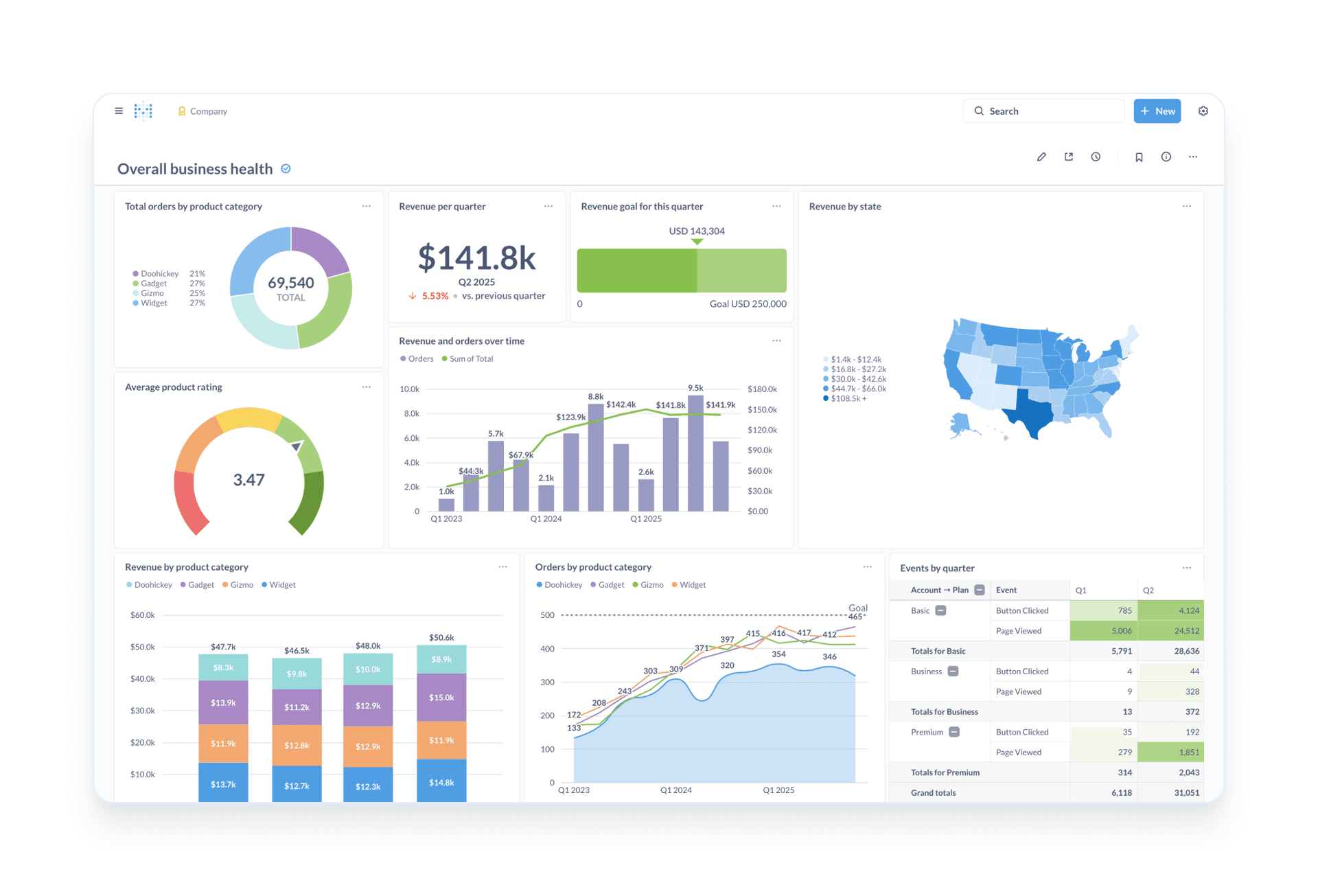
Metabase is the open-source tool for business intelligence – dashboards and analyses that are understandable even without SQL knowledge.
Self-hosted Metabase on European Infrastructure
We host Metabase in a GDPR-compliant way on European infrastructure, connect your data sources and set up the first dashboards. This way your team gets answers from your data without it passing through a third-party BI cloud tool.
The essentials of Metabase hosting
- Metabase is the open-source business intelligence tool – dashboards and analyses understandable even without SQL knowledge, hosted GDPR-compliantly in Europe by us.
- Departments answer their own questions instead of every analysis landing as a ticket with IT – the visual editor lowers the entry barrier for non-technical users too.
- We connect your data sources – from the production database to the data warehouse – and model them so analyses are reliable and understandable.
- Self-hosted, your business data does not leave your own infrastructure – unlike cloud BI, where exactly this data flows to third parties.
- We configure permissions and data access granularly, so each team sees only the analyses it needs and sensitive data stays protected.
Dashboards & self-service BI
Metabase makes data accessible: with questions in plain language or by click, analyses and dashboards are created without every question going through IT. Your team makes decisions based on current numbers instead of gut feeling.
Connecting your data sources
Metabase connects with common databases and data warehouses. We connect your sources – from the production database to the warehouse – and model them so analyses are reliable and understandable.
Self-hosted setup
Self-hosted, Metabase runs on your infrastructure, so your business data does not leave the house. We install Metabase production-ready, set up connections and ensure stable operation.
Access rights & data protection
Not everyone should see everything. We configure permissions and data access granularly, so each team sees exactly the analyses it needs – and sensitive data stays protected.
Metabase in action
Business intelligence for everyone – ask questions, build dashboards, no SQL required.
Self-hosted Metabase vs. Cloud BI
Whether data leaves your organisation or not is not a minor detail – here are the key differences at a glance.
| Cloud BI (SaaS) | Self-hosted Metabase | |
|---|---|---|
| Data protection / GDPR | Data flows to third parties | Data stays in-house |
| Infrastructure control | ||
| Customisation & embedding | Limited | Fully controllable |
| Ongoing licence costs | Usage-based, scales up | Open-source, fixed ops cost |
| Self-service for departments | ||
| Setup & operations | Ready to use immediately | Initial setup required |
Relative assessment; exact suitability depends on your infrastructure and data protection requirements.
Our setup process for your Metabase instance
From blank infrastructure to the first self-service dashboard – in four clearly defined steps.
Infrastructure & deployment
Deploy Metabase on European servers, configure GDPR-compliant hosting, set up TLS and backups.
Connect data sources
Establish connections to your database, data warehouse or CRM and verify connection stability.
Permission concept
Configure groups, collections and data access so everyone sees only what they are authorised to see.
First dashboards & handover
Set up initial reports together and introduce departments to the visual editor for self-service.
Each phase closes with a defined deliverable before the next one begins.
What matters for Metabase hosting
With self-hosted Metabase, the real value comes from departments being able to answer their own questions. When every new analysis no longer lands as a ticket with IT, the bottleneck falls away, and decisions are made faster and on data. The visual editor lowers the entry barrier far enough that non-technical people actually work with data.
But self-service does not exempt you from a clean data foundation. For analyses to be reliable, the connected data sources must be consistent and the terms defined, otherwise two dashboards answer the same question differently and undermine trust in the numbers. Well-made BI needs clear definitions before it is democratised.
The data protection advantage is concrete: with self-hosting, business data does not leave your own infrastructure, unlike cloud BI where exactly this data flows to third parties. In operation, performance on complex queries and a well-considered permissions concept decide that everyone sees only the data they are allowed to, and that analyses stay fast even as data volume grows.
Self-service instead of IT ticket
When departments can answer their own questions, the IT bottleneck disappears – and decisions are made faster and data-based.
Business data stays in house
Self-hosted, your data does not leave your own infrastructure – a clear advantage over cloud BI where data flows to third parties.
Low barrier to entry
The visual editor makes BI accessible to non-technical users too, so more people in the company actually work with data.
Metabase vs. Tableau, Power BI & Looker
BI tools bill per user – a wide reader base in particular gets expensive. Metabase is open source and self-hosted with no per-user licence. As of June 2026.
| Metabase (self-hosted) | Tableau Cloud | Power BI Pro | Looker | |
|---|---|---|---|---|
| Licence | Open source, €0 | Per user/month | Per user/month | On request |
| Price | Fixed ops, user-independent | Creator $75 · Viewer $15 | $14/user/mo | Enterprise/quote |
| Cost (20 users) | Unchanged (fixed fee) | ~$300–1,500/mo | ~$280/mo | individual |
| Data ownership | Your own EU servers | Vendor cloud | Microsoft cloud | Google cloud |
| Self-service | Questions without SQL, dashboards | Yes | Yes | Yes |
Vendor list prices, as of June 2026 (USD, billed annually). Metabase Cloud would start at $100/mo. Break-even: from roughly 10–20 users – especially with many read-only viewers – self-hosted Metabase is usually cheaper than per-user BI.
Dashboards on your own infrastructure
With us you're always at the forefront of enterprise software development and benefit directly from our extensive development know-how. Together we examine your business processes, identify key optimization potential and develop individually tailored solutions. Your business goals and expectations are the focal point of everything we do.
Comprehensive technological expertise
We choose the stack per project by requirement and rely on established, future-proof technologies instead of niche dependencies.
Specialized in enterprise solutions
The real lever lies in clean interfaces: we integrate deeply into ERP, CRM and third-party systems instead of isolated solutions.
Years of experience in the software industry
From requirements analysis to operation after go-live, we know the pitfalls of large software projects.
Multidisciplinary expert team
Analysis, architecture, backend and operations come together in one team, without friction between disciplines.
Long-term business success
We build maintainable foundations that grow with your company, and stay by your side with support and further development.


READY FOR SOFTWARE BUILT AROUND YOUR BUSINESS?

Related articles from our blog
Self-hosted instead of SaaS subscription: you can run these open source tools for free with Coolify
Heroku frozen, Vercel invoices viral: in 2026, it's worth taking a look at self-hosted SaaS alternatives. Which open source tools you can run for free with Coolify, what it really costs to run them and when the switch pays off.
n8n in SMEs: 7 workflow automations that pay for themselves in 4 weeks
From the third automation, Zapier tips into the three-digit monthly range. With n8n self-hosted, it remains at around 25 euros plus infrastructure. Seven specific workflows - invoice receipt, lead routing, threshold alerting, shop pipeline, contract terms, onboarding, daily briefing - each with a quantity structure and ROI calculation. Including self-hosting vs cloud decision and honest delineation of where n8n does not belong.
Voicebots for Business: Providers, Costs & GDPR at a Glance
Which voicebot providers are out there, what a voicebot costs and what you need to settle on data protection — the practical B2B overview for your decision.

Frequently asked questions