
Docker Agency
DOCKER REPRODUCIBLE DEPLOYABLE
With Docker we unify build, test and runtime environments – less "works on my machine", more predictability in production.






We arecontainerengineers
We design images, compose stacks and orchestration interfaces pragmatically – security and updateability included.
- Multi-stage builds and minimal base images
- Secrets, non-root users and healthchecks
- Registry strategies, tags and SBOM-oriented reviews
- Integration with GitHub/GitLab CI and Kubernetes/VPS
Portable artefacts
An image encapsulates runtime and dependencies – identical from local dev through staging to prod.
Composition & service mesh light
Docker Compose for local systems; in prod we hand off to orchestrators without vendor lock-in illusions.
Security hardening
Distroless/Alpine trade-offs, read-only filesystems and cap drops reduce attack surface.
Observability hooks
Structured logging, metrics sidecars and tracing headers: containers must fit into existing monitoring.

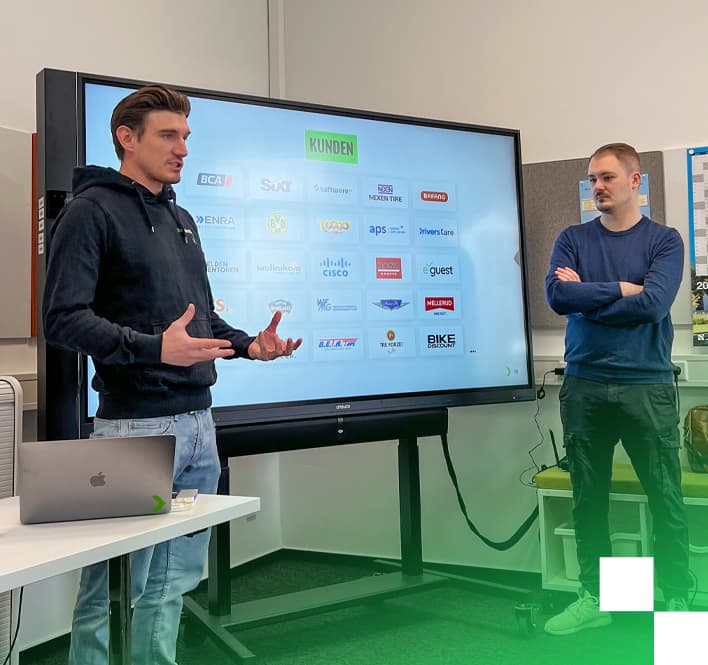
Selected references

Services &solutions
We modernise Dockerfile landscapes or start container-first – with clear governance rules.
- Containerising existing Node/Nest/PHP/Next services
- CI pipelines: build, scan, sign, promote
- Blue/green or rolling updates with health gates
- Cost and resource reviews
Microservices & APIs
Independent deployments per domain: images version contracts and ease rollbacks.
Preview environments
Pull request environments with real dependencies improve review quality before merge.

Frequently asked questions about Docker
Your question isn't here? Ask us directly
When does Docker actually pay off for our project?
Docker pays off most when you know the classic "works on my machine" problem: build, test and production environments drift apart and releases become unpredictable. We use containers to unify those environments and make deployments predictable. It is especially worthwhile when several services such as APIs, workers and frontends work together, or when you need reproducible builds in your CI/CD pipelines.
How exactly do you go about containerising?
We build images with multi-stage builds and minimal base images so they stay lean, fast and secure. Security is baked in from the start: non-root users, properly managed secrets and healthchecks for every service. On top of that we define a clear image strategy with tags and registry conventions, so you can always trace which version is running where.
How do you integrate Docker into our existing systems and pipelines?
We containerise your existing Node, Nest, PHP or Next services and wire them into your GitHub or GitLab CI. The pipelines cover build, scan, sign and promote, so only vetted images reach production. We stay flexible on operations: whether on a VPS or in Kubernetes, we adapt the orchestration to your infrastructure rather than the other way around.
How do updates and day-to-day operations work with containers?
For releases we rely on blue/green or rolling updates with health gates, so new versions only receive traffic once the healthchecks are green. We keep base image and dependency updates traceable through SBOM-oriented reviews and a clear registry strategy. That keeps your stack updateable without turning every deploy into a gut-feeling gamble.
When is Docker not the right choice?
If you run a single small application on classic hosting and need no scaling or complex environments, containerisation can add more overhead than value. Containers also don't fix architecture problems: a poorly designed service won't magically improve inside a container. We say openly when a leaner path makes more sense, and introduce Docker where reproducibility and scaling deliver real benefit.
Your edge with Docker
Containers are means to an end. We pay attention to start times, resource limits and clear observability – so ops sleeps soundly.
Experience with commerce and API workloads
Close DevOps cooperation with your teams
Disaster recovery and rollback paths
Cost-aware scaling
Ready for your Docker project?
Let's talk about your requirements – we'll get back to you within 24 hours with concrete next steps.

Docker Data & Insights
All postsRelated services
Related technologies
All technologies