App-Entwicklung: Web App Development & PWA
Web App Development
& PWA
Not every app needs to be in the store. Progressive Web Apps (PWA) and modern web apps run directly in the browser, can be installed on the home screen and work offline – no download hurdle, no store fees, cross-platform. We develop high-performance web apps and PWAs that feel like native apps and are accessible on any device with just one codebase.
Challenges you'll recognise
- You want users to try the app quickly, but the 'download from the store first' hurdle costs you reach.
- You want to serve smartphone, tablet and desktop but can't afford separate builds for each platform.
- Every update to your app has to pass the store review before it reaches users – critical fixes are delayed by days as a result.
Progressive Web Apps
A PWA combines the reach of the web with the convenience of an app. Users open it via a link, install it with a tap on the home screen and use it like a native app – including its own app icon, full-screen mode and push notifications. No app store, no download of hundreds of megabytes, no update friction.
Offline capability
With service workers and intelligent caching strategies your web app works even without a stable connection. Already loaded content stays available, inputs are cached and synced as soon as the connection returns. So the app stays usable on the train, in the elevator or with poor reception.
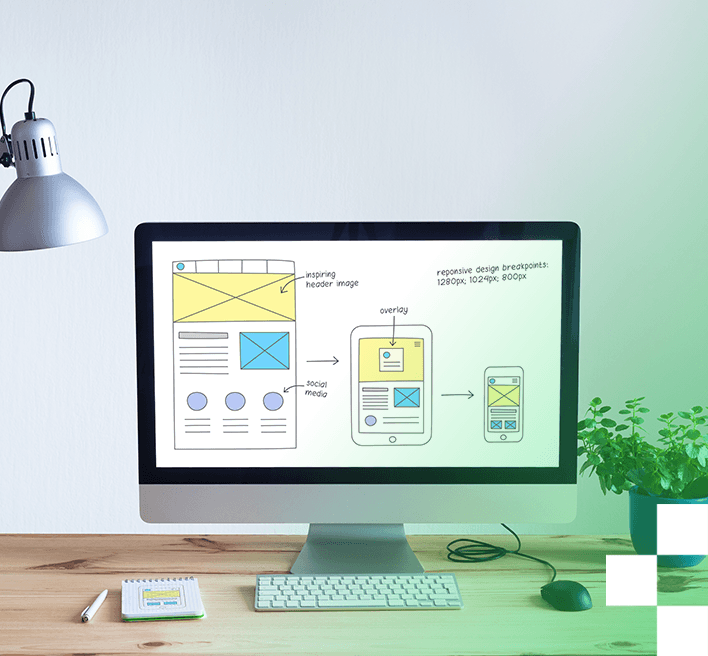
One codebase for all devices
A web app runs on smartphone, tablet and desktop – across all operating systems, from a single codebase. You reach users on iOS, Android, Windows and macOS at the same time, without separate builds. That significantly lowers development and maintenance costs and speeds up every release.
Modern frameworks
We build web apps with React, Next.js and Vue – frameworks that enable fast load times, clean architecture and excellent SEO. Server-side rendering, code splitting and optimized caching ensure the app starts quickly and stays performant even as the feature set grows.

Good to know
Installable without a store
A PWA is installed via the browser and appears with its own icon on the home screen – without an app store, without a review process and without downloading several hundred megabytes. That significantly lowers the barrier to entry for users.
Offline through service workers
Service workers are the technical heart of every PWA. They cache content intelligently, enable offline use and noticeably speed up repeat visits because resources are kept locally.
Discoverable via search engines
Unlike native apps, web apps are indexable by search engines. A technically clean PWA can be found via Google and thus become an acquisition channel itself – an advantage app-store apps don't have.
Your benefits
- Accessible on any device from a single codebase
- Installable on the home screen without an app-store detour
- Offline-capable through service workers and caching
- Instant updates without a store review for all users
- Discoverable via search engines – the app as an acquisition channel
- No store fees and no download hurdle
Success you can measure
With us you're always one step ahead technologically and tap directly into our extensive app development expertise. We take a close look at your app idea, identify key success factors and create tailor-made applications. Your visions and goals are at the heart of our joint project work.
Expert knowledge in app technologies
React Native, Flutter, native iOS and Android — we pick the stack to fit your project, not our preference.
Comprehensive user experience know-how
Intuitive operation and seamless interactions decide ratings and how long users stay in the app.
Proven track record
Published apps in the App Store and Play Store — from MVP to mature platform.
Versatile team
Concept, design, development and backend from one hand — no friction at the interfaces.
Long-term partnerships
We stay after launch and keep evolving your app with maintenance and updates.
Is this right for you?
These points help you gauge whether this service fits your situation.
- You want to reach users without a download hurdle and lower the barrier to entry.
- Your app should run on smartphone, tablet and desktop at the same time – from one codebase.
- You need fast release cycles without waiting on store reviews.
- Your app content should also be discoverable via search engines.
- You need offline capability but no deep access to special native hardware features.
Frequently asked questions
What is the difference between a PWA and a native app?
Does a PWA work on the iPhone?
Can a web app work offline?
Does a PWA need an app store?
Is a web app faster to build than a native app?
Related articles from our blog
READY FOR YOUR APP THAT SETS NEW STANDARDS?
Whether you want to optimize an existing app or bring a new vision to life – we'd love to meet you. A no-obligation conversation is always a great start.